
Article: Body Systems Thinking
Body Systems Thinking
Responsible Leadership – Systems Thinking NuSpecies SDAE (Body Systems Integration)
Efficiency Is Not Enough. A System Must Also Deserve Our Trust.
My work in corporate law and legal services at Fried, Frank, Harris, Shriver & Jacobson, followed by contract negotiation and patent inventions at IBM, taught me to look beyond the visible transaction.
At IBM, I led and co-led global outsourcing negotiations for many Fortune 500 companies and also served as lead inventor of Contracts Online, later co-leading its development and deployment with business executives, attorneys, and IBM Research engineers.
The challenge was larger than an electronic signature. It was creating a corporate enterprise architecture process in which identity, authority, consent, access, and accountability remained connected.
That experience left me with a question:
What must remain protected while a system performs its work?
Family illness and more than two decades of charitable and nutritional-support work brought the human stakes into sharper focus. At NuSpecies, our commitment is to education, nourishment, and appropriate wellness support alongside—not instead of—medical care.
These fields have different methods and standards of evidence. A person is not a machine. A biological process is not a legal agreement. Yet these experiences have shaped a common discipline in my work: scientifically examine the relationships and consequences, not only the isolated result.
That discipline informs Singularity Dual-Aspect Emergence—SDAE—and The Mathematics of Becoming.
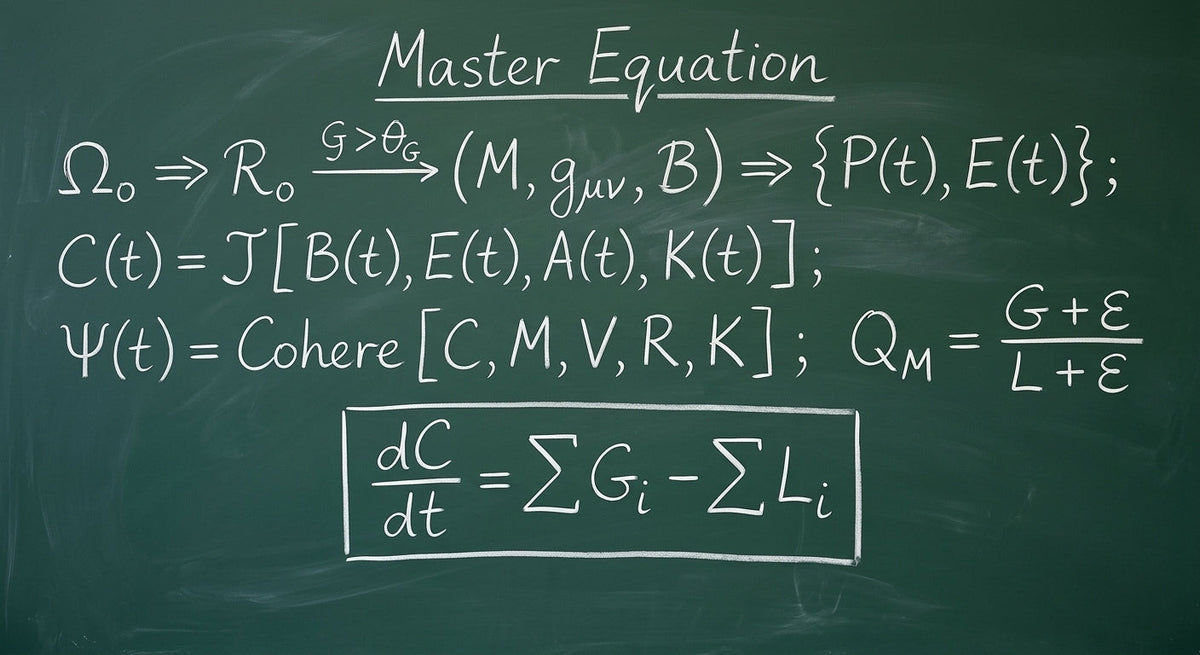
To map this rigorous approach mathematically, we establish the system's foundational transition:
Ω0 ⇒ R;0 → G;>θc (M,gμν, B;) ⇒ {P(t),E(t)}
Where systemic metric values C(t) map structural interaction variables:
C(t) = &backscriptJ;[ B(t), E(t), A(t), K(t) ] 1
While overall coherence state Ψ(t) and the functional balance metric QM align as follows:
Ψ(t) = Cohere [C,M,V,R,K] ; QM = G+ε / L+ε
Governed ultimately by the system's dynamic law of rate-of-change balance:
dC dt = ∑Gi − ∑Li
The Canon asks us to consider physical conditions, lived experience, the organization of relationships, and ethical responsibility together—without pretending they are interchangeable. In Book II.8, this becomes a practical requirement: an explanation must make its evidence, assumptions, limitations, and conditions for revision visible.
That is not merely a publishing standard. It is a leadership standard.
A favorable business metric should not conceal the burdens behind it. An elegant model should not be mistaken for the reality it describes. A person's experience deserves attention without being turned into proof of a universal claim.
For me, coherence is not conformity, perfection, or a single score. It is the continuing work of bringing knowledge, purpose, action, and responsibility into better relationship—while wisely preserving room for difference and correction.
We should ask more of progress than speed, scale, and output.
What does it protect? Whose burden does it increase? What can it repair? What does it leave possible for the next generation?
Those are the questions I carry from enterprise systems into the human responsibilities of NuSpecies and SDAE for good health and longevity. Reality remains the measure. Human dignity remains non-negotiable.
This is for informational purposes only. For medical advice or diagnosis, consult a medical professional.